

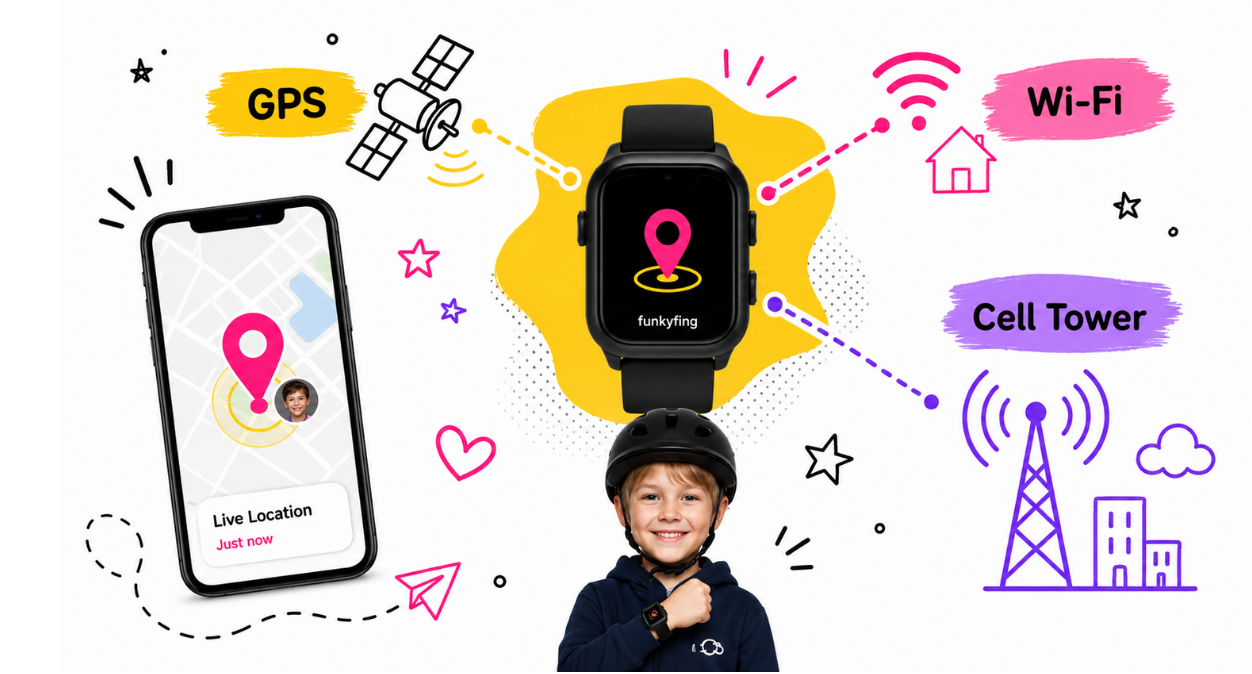
How does a kids' GPS smartwatch find your child?
A kids' GPS smartwatch finds your child by combining three independent location technologies — GPS, Wi-Fi, and cell towers — and choosing the strongest signal available at any moment. No single method works everywhere: satellites struggle indoors, Wi-Fi needs nearby networks, and cell towers only narrow things down to a general area. Used together, they cover each other's blind spots.
This is the same multi-layer approach used across the kids' GPS watch category, and it's why a modern watch can keep a location lock as your child moves from the playground to the classroom to a friend's flat. The watch quietly works out which signal is most reliable right now and reports that position to your phone in real time through the companion app.
The Funkyfing Jr2 runs all three layers continuously rather than switching to a backup only when the primary fails. That always-on design is the difference between "the watch usually knows where my child is" and "the watch almost always does."
Layer 1: GPS — pinpoint location from space
GPS is the most accurate layer, typically locating your child to within about 10 metres outdoors under clear sky. The watch listens for signals broadcast by navigation satellites orbiting the Earth and calculates its position by measuring exactly how long each signal takes to arrive. With enough satellites in view, that produces a tight, reliable fix.
This is the layer most people picture when they hear "GPS tracking," and it's the one you'll rely on when your child is walking home, at sports, or anywhere with an open view of the sky. For context, the US government's GPS performance data shows consumer GPS receivers are typically accurate to within roughly 5 metres of your true position under open sky — so a wrist-worn device sitting around 10 m is realistic and dependable.
GPS has one well-known weakness: it needs to "see" the sky. Walls, roofs, tall buildings, and dense tree cover block or scatter satellite signals, which is exactly where the next two layers earn their place.
Layer 2: Wi-Fi positioning — locating indoors without connecting
Wi-Fi positioning lets the watch work out its location indoors — to within roughly 450 metres — without ever joining a network. The watch simply sees the Wi-Fi access points around it, including ones it never connects to. Because most Wi-Fi points have a known, mapped location, the watch can match the networks it detects against that map and estimate where it must be standing.
This matters because GPS often falls over indoors, and children spend a lot of their day inside — classrooms, shopping centres, sports halls, friends' homes. Wi-Fi positioning steps in precisely where satellites can't reach, giving you a usable location when the GPS layer goes quiet.
It's worth being clear about the privacy side: the watch isn't logging onto Wi-Fi or browsing anything. It's reading the presence of nearby networks as landmarks, the same way you might recognise a street by its shop signs without walking into any of them.
Layer 3: Cell tower location — always-on coverage
Cell tower location gives the watch a rough position — usually within about a kilometre or more — anywhere there's mobile signal. This is sometimes called LBS (Location-Based Services). The same cellular signal that carries a voice call also tells the watch roughly where it is: by listening to several towers at once and judging which are closest, the watch estimates its position from the network alone.
It's the least precise of the three layers, but also the most resilient. There's mobile coverage in places GPS and Wi-Fi can't help — and as a backstop, "within a kilometre" is far better than "no idea." It keeps a location flowing while the more precise layers reacquire a lock.
In practice you rarely notice this layer doing its job. It runs underneath the others, quietly guaranteeing that the watch is never completely in the dark about where your child is.
Why three layers beat one
The reason kids' GPS watches use three systems instead of one is simple: each layer covers what the others can't. GPS nails outdoor accuracy but fails indoors. Wi-Fi rescues indoor locations but needs nearby networks. Cell towers reach almost everywhere but only approximately. Stack them, and the gaps disappear.
Here's how the three layers compare:
| Layer | Source | Typical accuracy | Strongest where |
|---|---|---|---|
| GPS | Navigation satellites | ~10 m | Outdoors, clear sky |
| Wi-Fi | Nearby networks | ~450 m | Indoors |
| Cell tower | Mobile network | ~1 km+ | Anywhere with signal |
When all three run at the same time, the watch always has a fallback. Your child steps into a shopping centre and GPS drops — Wi-Fi takes over. They walk into a basement with no Wi-Fi — the cell network keeps a rough fix alive. One layer covers what another can't, which is the whole point of the design.
How accurate is a kids' GPS watch, really?
Outdoors, a kids' GPS watch is typically accurate to within about 10 metres — close enough to tell which part of a park or street your child is on. Indoors or in dense urban areas, accuracy widens because the watch is leaning on Wi-Fi or cell signals instead of satellites. That's not a flaw; it's physics. Every GPS device on the market, including your own phone, behaves the same way.
The honest framing is this: a kids' GPS watch is built to answer "roughly where is my child right now, and are they where they should be?" — not to map them to the exact paving slab they're standing on. For a parent checking that a child made it to school, left a friend's house, or hasn't wandered out of a safe area, that level of accuracy does the job well.
No GPS tracker is 100% accurate 100% of the time, and any honest brand will say so. Signal blockage, buildings, and weather all nudge the numbers. The three-layer system exists specifically to keep a reasonable location available even when conditions aren't ideal.
Does a kids' GPS watch work indoors?
Yes — a kids' GPS watch works indoors, but it uses Wi-Fi and cell tower positioning rather than GPS to do it. Satellite signals weaken badly once there's a roof overhead, so a GPS-only tracker becomes unreliable inside. A three-layer watch sidesteps that by falling back to the Wi-Fi networks and cell towers it can still detect.
The trade-off is precision: indoors you'll typically get a location accurate to a few hundred metres rather than the ~10 m you'd see outdoors. That's usually enough to confirm a child is at school or inside the shopping centre, even if it won't tell you which floor.
This is exactly why the multi-layer approach matters for children specifically. Kids spend large parts of their day inside, so a tracker that only worked under open sky would go blind for hours at a time. Wi-Fi and cell positioning keep the watch useful through the school day.
FAQ
How do GPS watches for kids track location?
They combine three technologies — GPS satellites for outdoor accuracy, Wi-Fi positioning for indoor coverage, and cell tower location as an always-on fallback — and report the strongest available position to a parent's phone in real time.
How accurate is a kids' GPS smartwatch?
Outdoors, typically within about 10 metres. Indoors or in built-up areas it's usually accurate to a few hundred metres, because the watch relies on Wi-Fi or cell signals when satellites are blocked.
Does a kids' GPS watch need Wi-Fi or internet to work?
No internet connection is required for tracking. The watch detects nearby Wi-Fi networks as location landmarks without joining them, and uses the mobile network for GPS data and calls — it doesn't browse the web or use social media.
Can a GPS watch track my child indoors?
Yes. When GPS signals are blocked by a roof or walls, the watch switches to Wi-Fi and cell tower positioning, so you still get a usable location inside schools, malls, and homes.
Is a kids' GPS watch better than giving my child a phone?
For location and safety, a GPS watch gives you the tracking and voice contact a phone offers without the internet, social media, and stranger contact a smartphone brings — which is the core reason many parents choose one.
The bottom line
A kids' GPS smartwatch keeps track of your child by layering three location technologies so that no single weak spot leaves you guessing. GPS handles the outdoors, Wi-Fi handles indoors, and cell towers cover everywhere in between. The more you understand how it works, the easier it is to trust what it tells you — and that peace of mind is the entire point.
Share:
How to Stay Connected With Your Child Without Giving Them a Phone